
Shifting Gears for Steady Progress in China-Australia Trade and Economic Cooperation
Remarks by H.E. Ambassador Liu Jinsong at the ACBC Canberra Networking Day 2026
October 15, 2026
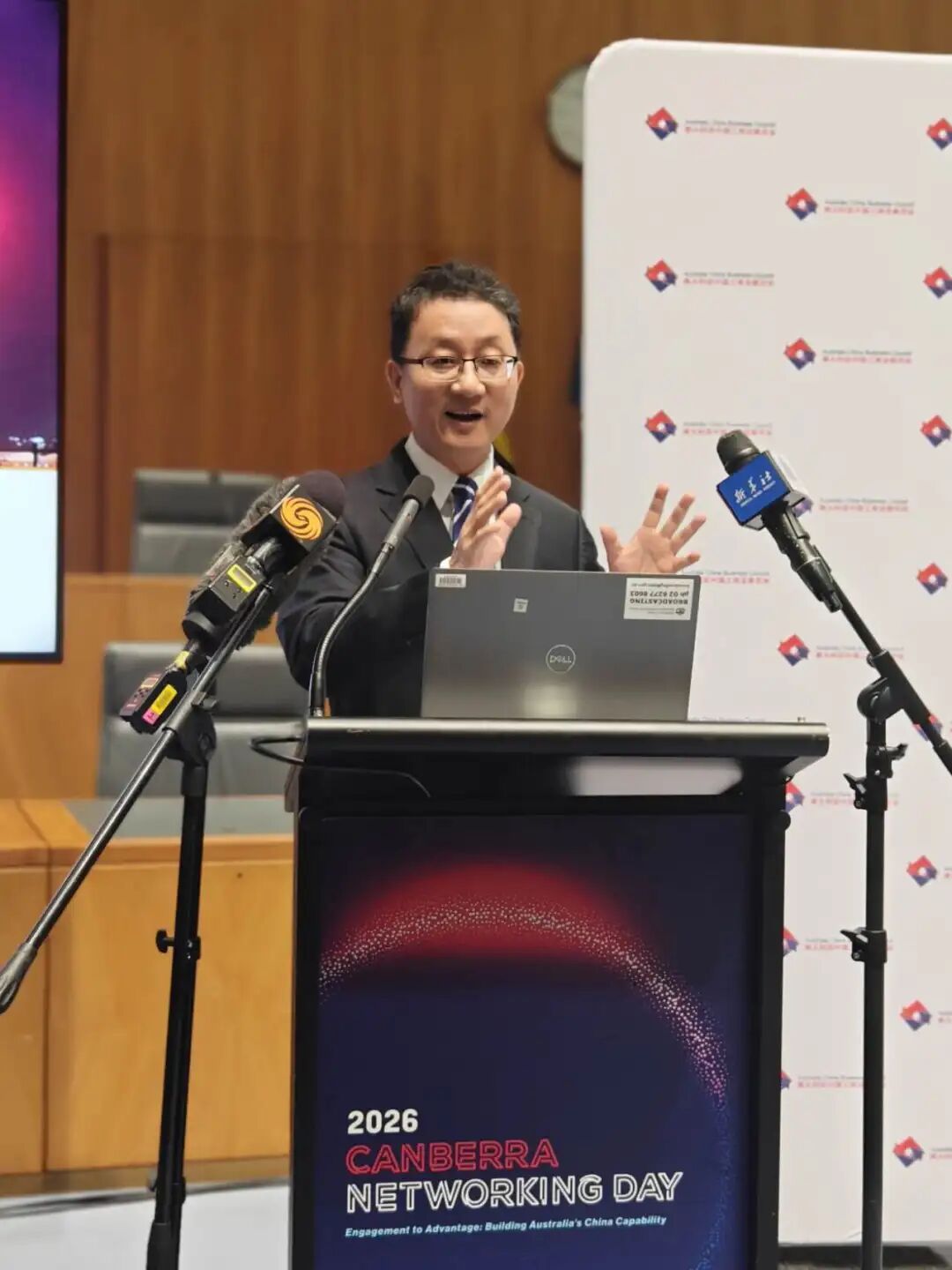
Ladies and Gentlemen,
Good morning. I’ve brought a bus model here to the Parliament house today. As you may recall, I actually travelled from Sydney to Canberra by coach when I first arrived—people were quite intrigued by that. Well, here’s the detail: it was a Murrays coach and it carries a Chinese element!
I would like to sincerely thank the Australia China Business Council (ACBC) and National President Rhys Roberts for your kind invitation, and extend my warm congratulations on the successful convening of this Canberra Networking Day. I also wish to express my appreciation to the Chinese and Australian business communities for your tireless efforts over the years in paving the way and building bridges for economic and trade cooperation between our two nations.
When we talk about China-Australia economic and trade cooperation, the first things that come to mind are probably iron ore, energy and agricultural products. In 2025, total two-way trade in goods and services reached approximately AUD326 billion. China has been Australia’s largest trading partner for 17 consecutive years. In the first eight months of this year, bilateral merchandise trade totalled USD176.9 billion, growing by nearly 34.8% year on year, which is not easy in the context of sluggish global economic growth and strong headwinds to global trade. By way of breakdown, Australia’s export to China reached USD120.2 billion, up by 43.2% year on year, accounting for over one third of Australia’s total export. Behind these numbers lies the hard work of businesses on both sides: deal by deal, shipment by shipment, and step by step.
Yet beneath the surface, the nature of our economic and trade cooperation is quietly evolving. While our partnership was largely driven by trade in goods, today we are seeing growing two-way flow of technology, services and innovation. China-Australia trade and economic cooperation is shifting gear, with traditional drivers remaining strong and new sources of growth emerging.
The first company I visited after arriving in Australia was a Chinese auto manufacturer. They told me that Chinese-made electric vehicles offer excellent value for money and a comfortable ride, and have won the hearts of Australian consumers. This year, the share of pure electric vehicles in their Australian sales has continued to rise. More and more electric vehicles are now running through the streets of Canberra, Sydney, Melbourne and other cities. Chinese electric vehicles can make a meaningful contribution to Australia’s energy saving and emission reduction efforts, and offer a practical solution to households coping with rising fuel costs. They also create new opportunities for green, smart Chinese-made products to demonstrate their value. An Australian employee of the company told me he hopes that one day he can take his family and friends on a Chinese-made electric vehicle to tour the Great Barrier Reef and the Queensland rainforest. So electric vehicles connect not only Chinese industry with Australian consumers, but also our two countries through a shared vision of a greener future.
And this is one of many such stories. A colleague told me about an Australian company that brought its world-leading cochlear implant technology to China. By partnering with Chinese medical and research institutions, it has helped more than 60,000 hearing-impaired people in China regain their hearing. This company did not just sell products into China; it has deeply integrated R&D, manufacturing and local medical services, planting the seeds for the development of industry chains, clinical care and rehabilitation systems across China.
Sports offer another fascinating stage. During the FIFA World Cup Qatar 2022, Chinese companies were deeply involved, from the steel structure of Lusail Stadium to the merchandise in fans’ hands, to the LED screens and communications networks inside the venues. It seems you don’t have to score a goal on the pitch to find your way into a global sporting event. The next major event on the horizon is the Brisbane 2032 Olympic Games. This will not only be a sporting spectacle for Australia, but also a major opportunity for Chinese and Australian businesses to cooperate in infrastructure, sports technology, clean energy, smart transport and event operations. I also learned that a Chinese AI-empowered sports technology company reached an agreement with Tennis Australia to become the official ball machine supplier for the Australian Open. AI-empowered sport is a vivid example of how our two countries are working together at the intersection of sport and innovation.
New frontiers for China-Australia economic and trade cooperation are opening up one after another. Cooperation in traditional areas continue to deepen, while progress in new areas is gaining momentum. Seeing these changes, we should ask ourselves: How can we further tap into the new drivers of China-Australia economic and trade cooperation? What will it take to nurture further growth? My answer is simple: consolidating and advancing the China-Australia Comprehensive Strategic Partnership is the essential foundation for steady and sustained progress in our economic and trade cooperation.
Under the strategic guidance of our leaders, China-Australia relations have returned to the right track of stable and sound development, and practical cooperation across all fields is advancing. Over the past few years, President Xi Jinping and Prime Minister Anthony Albanese have met four times, providing strategic direction for the bilateral relationship. Late last year, Zhao Leji, Chairman of the Standing Committee of the National People’s Congress of China, paid a successful visit to Australia. This year, the Honourable Milton Dick, Speaker of the House of Representatives of Australia, led a delegation to China, and exchanges between our legislatures continue. Next month, the APEC Economic Leaders’ Meeting will be held in Shenzhen, China, offering another important opportunity for high-level dialogue and promoting bilateral trade and economic cooperation.
The year 2027 holds special significance for both countries. China and Australia will celebrate the 55th anniversary of diplomatic relations. China will mark the centenary of the founding of its People’s Liberation Army and the 30th anniversary of Hong Kong’s return to the motherland, and will host the BRICS Summit, alongside other important political events within the year. Meanwhile, Australia will celebrate the centenary of relocating its Federal Parliament to Canberra. This convergence of milestones in a single year presents a historic opportunity to expand our cooperation.
During his meeting with Prime Minister Albanese last year, President Xi Jinping noted that “treating each other as equals, seeking common ground while shelving differences, and engaging in mutually beneficial cooperation serve the fundamental interests of both China and Australia and the two peoples. No matter how the global landscape shifts, these principles should remain the guiding compass for both countries.” This concise statement captures the underlying logic of steady, enduring progress in China-Australia relations.
Treating each other as equals is the cornerstone of our engagement. As the Chinese saying goes, “Courtesy demands reciprocity”; Australians speak of “a fair go”. Both express the same core value: mutual respect. Australia values its agricultural and food exports to China; China is concerned with the interests of Chinese companies in Australia, particularly the need for Australian policies and laws to provide transparency, predictability, stability and non-discrimination. These concerns must be addressed on an equal, balanced and amicable basis. Only when we hold both our own and our partner’s core interests and concerns in equal regard can dialogue be meaningful and cooperation have firm foundations.
Seeking common ground while shelving differences is the glue that holds consensus together. China and Australia differ in national conditions, systems and stages of development. It’s perfectly normal to have differences. It would be unrealistic to expect none. What matters is how to manage differences rationally and properly to grow our bilateral relationship. Cooperation is not about moulding each other into the same shape; it is about making the shared cake bigger, while managing differences appropriately. We must never allow disagreements to define our bilateral relations.
Mutually beneficial cooperation is what drives sustained, steady progress. Businessmen speak of “win-win.” Only when all sides benefit can a venture endure. The Chinese and Australian economies are highly complementary. Each has its own industrial strengths and our market needs align in many ways. This makes us natural partners. The key lies in strengthening the mainstays of traditional cooperation while bringing fresh flavors and new offerings to emerging fields, translating complementary advantages and market opportunities into tangible cooperation outcomes that benefit both peoples.
Australians often speak of “mateship”—standing together through storms and sharing the rewards when times are good. Only when both sides recognise that our futures and interests are intertwined, see each other’s success as our own opportunity, respect each other, and genuinely appreciate and support one another can our cooperation continue to deepen and flourish.
At present, global political and economic uncertainty is rising. Protectionism and unilateralism are gaining ground, while normal economic, trade and technological exchanges are increasingly securitized and politicized. It is precisely in such times that the Chinese and Australian business communities must bring their entrepreneurial and contractual spirit to the fore. It is vital to respect market principles and economics, safeguard what you have achieved, and cultivate new growth drivers. Ultimately, the vitality of our economic ties lies not only in what you have built together, but also in your ability to adapt, innovate, and create new opportunities.
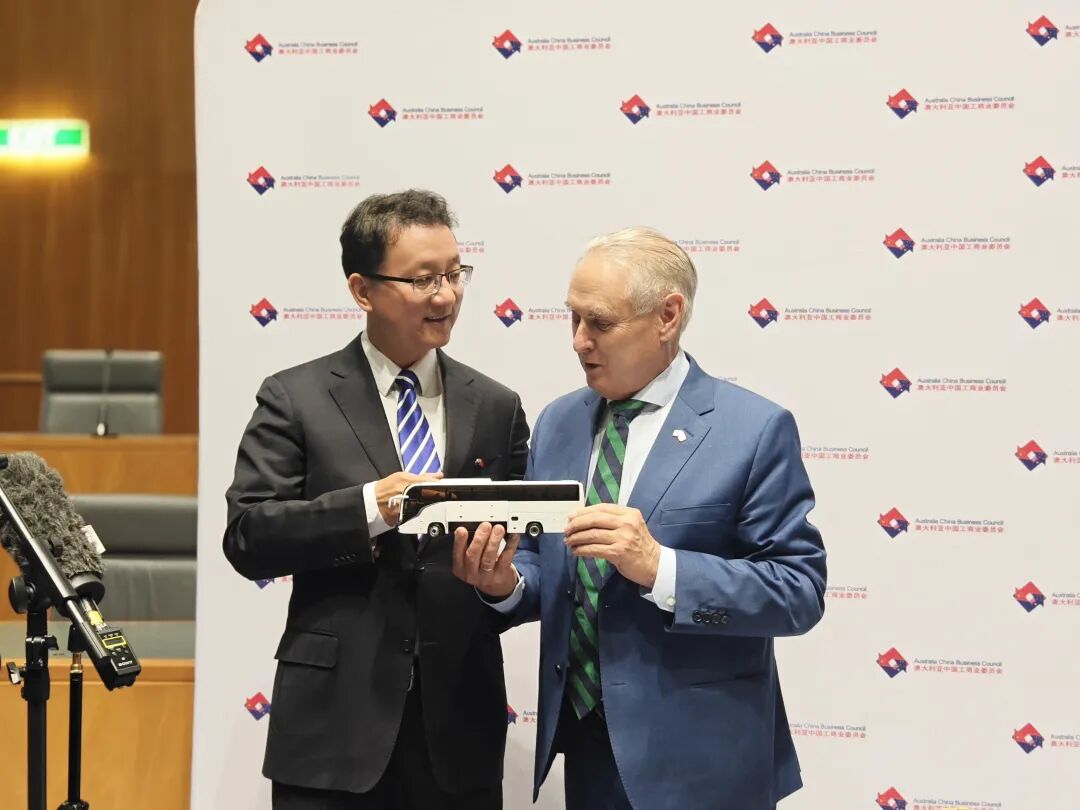
The bus model I brought with me is a flagship model that enjoys strong sales and an excellent reputation here in Australia. It is a hybrid, representing the integration of traditional and new drivers of growth. For a vehicle to travel safely and go the distance, it needs a good driver, headlights to see the road ahead, rear-view mirrors to avoid hazards, and, crucially, government and all sectors of society working together to build good roads and sound rules. I hope that in a fair, reciprocal, transparent, friendly and comfortable traffic system, we can drive forward smoothly, straight ahead, whatever the weather.
Thank you.