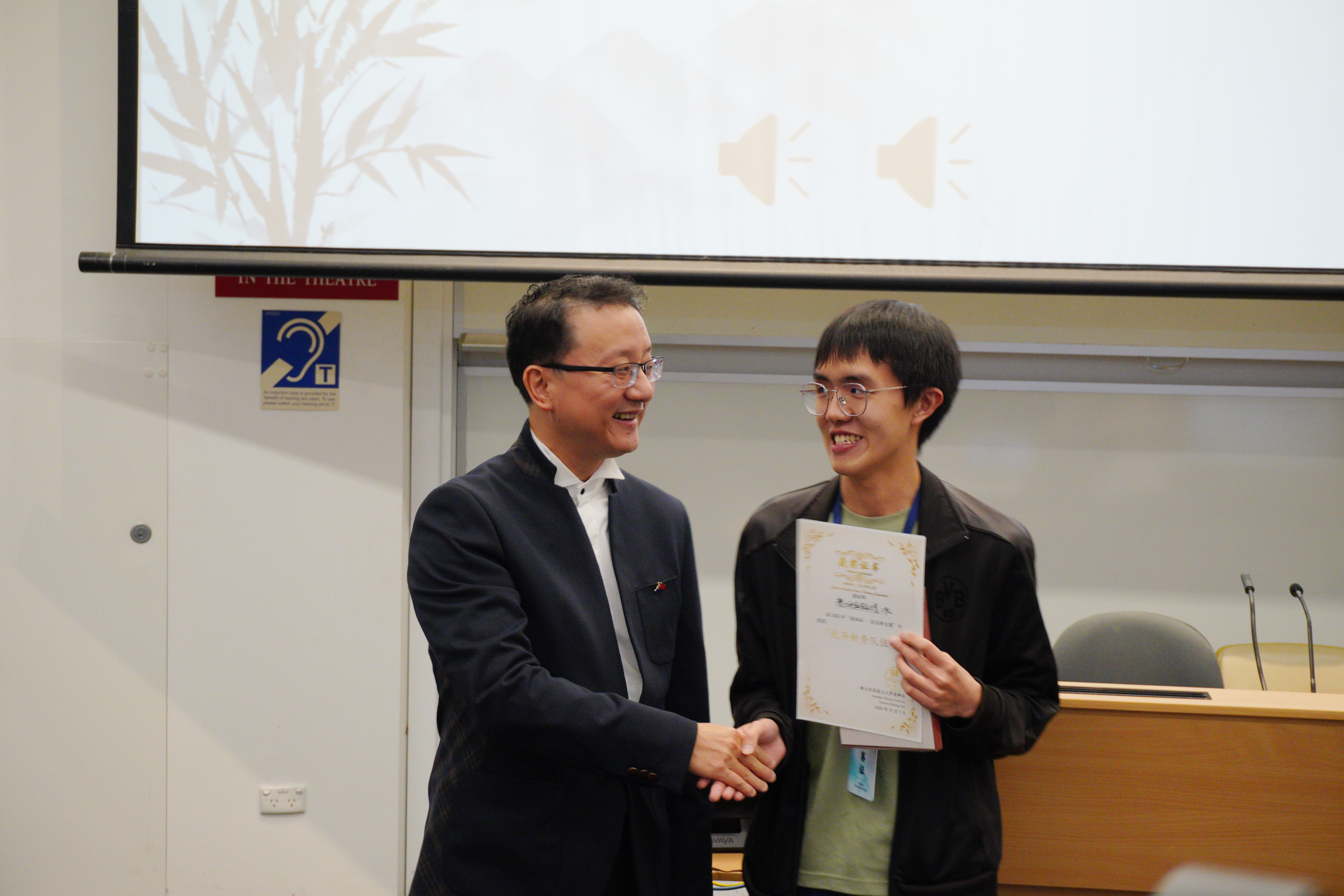
[On 5 October 2026, Ambassador Liu Jinsong was invited to attend the Awards Ceremony of the 6th Australian Chinese-Language Debating Competition (Eastern Region Novice Tournament). He spoke warmly with the students and presented awards to the winning teams and debaters. More than a hundred people attended the competition, including debaters from five universities across eastern Australia and Chinese student representatives in the Australian Capital Territory. Ambassador Liu delivered the following remarks:]
First, warm congratulations to the winning teams and all the debaters who took part in this competition! I also want to express my appreciation to all the organizers, adjudicators and participants.
Today is still within China's National Day holiday, and it is also a public holiday in Canberra. You use your holiday to take part in the competition with such enthusiasm and competitive spirit, demonstrating your passion for Chinese culture and for debating. My colleagues at the Embassy and I have been following the competition closely and have been deeply encouraged by it.
When I was at university, I watched the Singapore International Varsity Debate. Its historic scenes and brilliant moments are still vivid in my mind, and the phrase "my opponent" still echoes in my ears. For many years I have used "Battle of Words in the Lion City" as a practical teaching resource for diplomatic debate among my younger colleagues. Watching your debates today, I have felt the same excitement and the same sense that each generation pushes the one before it forward.
Everyone who has been through a debating competition takes something away from it, and I would like to share my understanding of debate. I believe that debate is an integration of the "Dao" (principle), the "Shu" (technique) and the "Xing" (practice).
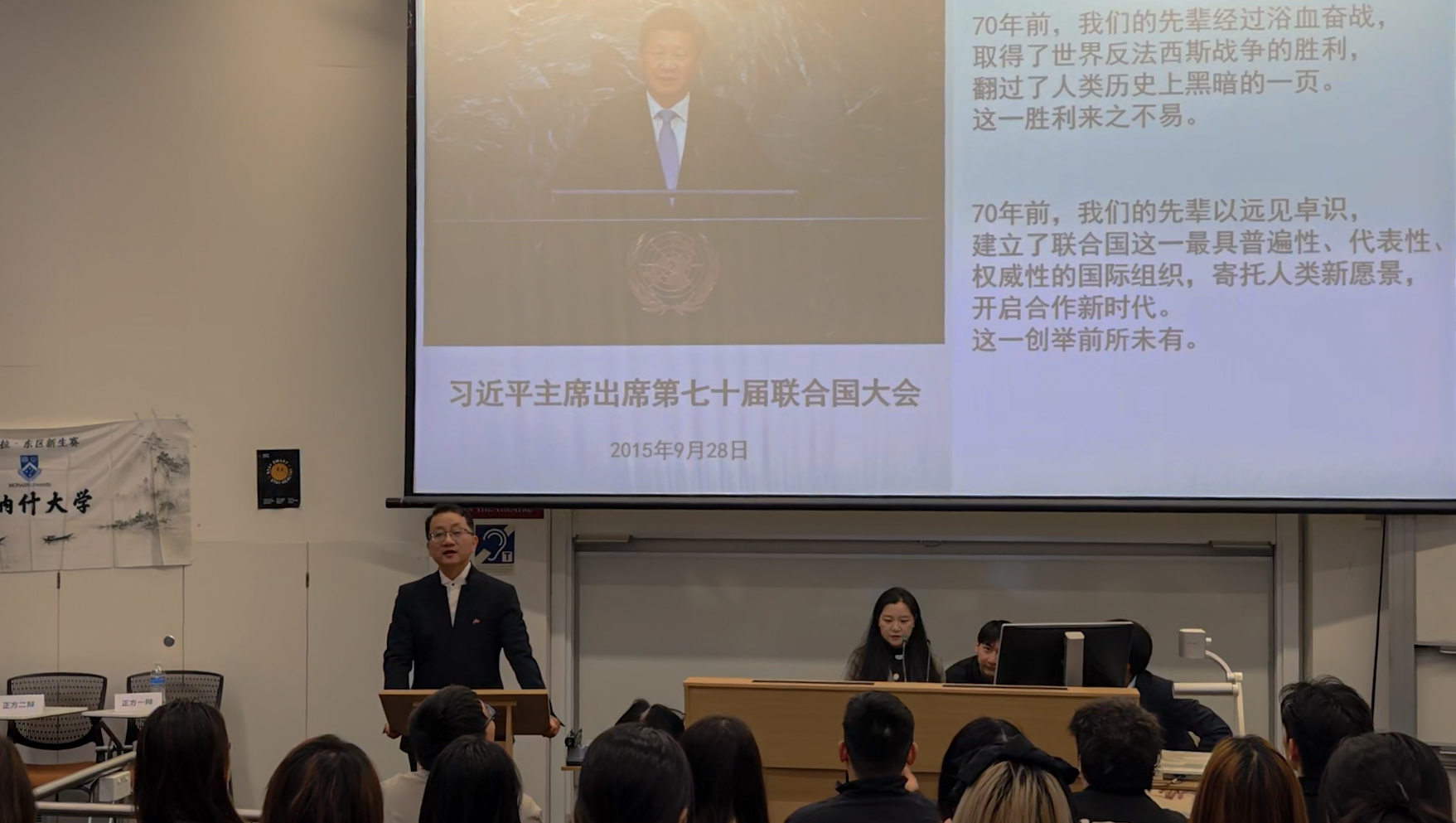
As for the "Dao" (principle), I invite you to reflect on President Xi Jinping's speech at the General Debate of the 70th Session of the United Nations General Assembly in 2015. It was one of the highest-level debates in the world, and a comprehensive explanation of China's domestic and foreign policies. At the commemoration of the 70th anniversary of victory in World War II and of the founding of the United Nations, President Xi began by making the fundamental point that, 70 years ago, our predecessors fought heroically and secured victory in the World Anti-Fascist War, thereby turning a dark page in human history. That victory was hard won.
He went on to say that, 70 years ago, with vision and foresight, our predecessors established the United Nations, the most universal, representative and authoritative international organization, placing their hopes in a new future for humanity and ushering in a new era of cooperation. This was a pioneering initiative unprecedented in human history.
These two statements immediately place the discussion on the commanding heights of history, our times and morality. President Xi further noted that history is a mirror, and only by drawing lessons from history can we avoid repeating past mistakes. As the ancient Chinese saying goes, "When the Great Way prevails, the world belongs to all." We should inherit and advocate the purposes and principles of the UN Charter, establish a new type of international relations with win-win cooperation at the core and forge a community with a shared future for mankind. Let the philosophy of beating the swords into ploughshares and never engaging in war again be deeply-rooted in people’s mind and let the notion of development, prosperity, fairness and justice be implemented in the world.
These words build step by step, with tight logic, elegant language and significant impact. They revolve around the major initiative of a community with a shared future for mankind, stay closely tied to the theme and background of the 70th anniversary of the victory in World War II and of the UN, address the common concerns and aspirations of the international community, and represent the strength and voice of 1.4 billion Chinese people. This is the Dao, the power of truth. As the ancient Chinese philosopher Mozi said, the purpose of debate is to distinguish right from wrong, to examine the principles of order and disorder, to clarify similarities and differences, and to investigate the logic of names and realities. Only when debate is for the Dao, accords with the Dao, and serves the Dao, does it have soul, strength and the power to inspire.
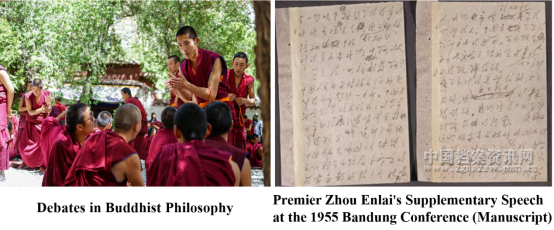
As for the "Shu" (technique), before coming to Australia, I was responsible for foreign-related affairs concerning Xizang. I visited several major Tibetan Buddhist monasteries in Lhasa and also went to the High-Level Tibetan Buddhism College of China in Beijing to observe debates in Buddhist philosophy, which form part of the requirements for obtaining advanced academic degrees. Let me show you two short videos. The debate has rhythm, expression and one climax after another, and it holds your gaze. Although I cannot follow everything that is being debated, I could appreciate what the Greek historian Tacitus meant in regarding eloquence as the princess of the arts. It also fits the motto of today's competition: "Clash of ideas, brilliance of words." Scriptural debate has a questioner and a respondent, basic etiquette, and a rigorous syllogistic structure. It has standard formulas for questions and answers, progressive reasoning, and a halt for violations of the rules. Its purpose is to clarify concepts, reinforce memory, and cultivate critical thinking and compassion, that is, "using debate to nurture wisdom, and using wisdom to guide action." Seen from another angle, this form of debate is a vivid example of how the Chinese government protects freedom of religious belief and promotes the traditional cultures of ethnic minorities.
As for the "Xing" (practice), it means applying debate to your daily study and life: telling China's story well, showing the character and responsibility of citizens of a major country, and serving as envoys for people-to-people and academic exchanges between China and Australia. I don't mean for you to become “professional arguers” or “contrarians” (laughter). What I hope is that you understand this: although China and Australia diplomatic relations will soon reach 55 years, and although we have extensive exchanges and deeply intertwined interests, differences in national conditions, systems and cultures mean there are many differences in perception and disagreements between us, including on democracy, human rights, Xizang, Xinjiang, Taiwan and Hong Kong. These call for candid communication, and sometimes for debate that does no harm to goodwill: speaking from personal experience, backing your points with facts, and persuading with reason. Of course, when some people deliberately smear China and undermine China-Australia relations, only a firm and forceful rebuttal can let righteousness prevail over wrongdoing. New China has achieved two miracles, rapid economic development and long-term social stability, as well as a poverty-alleviation achievement rarely seen in human history. Everything our governing party and governments at all levels do benefits China and the world, and is open and above board. As the saying goes, "A lamp does not brighten without being trimmed, and truth does not become clear without debate." We have every reason to be confident, and we are not afraid of debate. The ones afraid of debate are precisely those with ulterior motives who fabricate stories.
I often say this about Premier and Foreign Minister Zhou Enlai at the 1955 Bandung Conference. Facing criticism, suspicion and confrontation at the critical moment that would decide the conference's success or failure, he made a supplementary speech that went down in history. He set aside his prepared text and had a new one drafted on the spot. When he walked to the podium, his opening words were calm yet immensely powerful: "The Chinese Delegation has come here to seek unity and not to quarrel. " The opening immediately brought the entire hall to silence. He went on to say: "We Communists do not hide the fact that we believe in communism and that we consider the socialist system a good system. But there is no need at this Conference to publicize one’s ideology and the political system of one’s country. " He put forward the principle of "seeking common ground while reserving differences, " calling on Asian and African countries to seek common ground and to respect, sympathize with and support one another. His 18-minute impromptu speech was met with thunderous applause from the audience. Western journalists commented that Premier Zhou was deeply impressive: he dispelled doubts, won friends and broke through the diplomatic isolation surrounding China.
This reminds me of something a Western statesman said: the virtues that must not be neglected in debate are respect, fairness and modesty. Karl Marx put it better: In debate, showing your own cultivation matters more than proving your opponent's ignorance.
Today I wanted to chat with you about debate in a relaxed way, so I won't debate you directly. I might not be able to out-argue you (laughter). I hope we can learn from each other and encourage each other, and work tirelessly for mutual understanding and closer ties between the peoples of China and Australia.
* * *
The representatives of the champion team and the best rookie debater thanked Ambassador Liu for his words of encouragement and for presenting the awards. They also thanked the Australian National University Chinese Debating Society for its hard work in preparing and successfully hosting the tournament, which gave novice debaters a platform for competition and exchange. They said that although travelling to Canberra by car or plane was tiring, it was well worth it. They expressed confidence that the spark carried by these rising debaters will one day create massive effect.
The Australian Chinese-Language Debating Competition (Eastern Region Novice Tournament) has now been held successfully six times, supplying and training Chinese-language debating talents for higher-level tournaments across Australia and around the world. Eight teams from five universities took part this year: the Australian National University, the University of Melbourne, Monash University, the University of Sydney and the University of Queensland. The University of Melbourne's Team One and Monash University's Team Two took the Champion and Runner-Up respectively.