
On July 1, 2026, Chinese Ambassador Xiao Qian published an article entitled When will the China-threat paranoia stop? in The Sydney Morning Herald and The Age, rebutting that certain Australian organizations and media outlets have repeatedly fabricated and hyped falsehoods and fallacies regarding the security threat posed by China, emphasizing that relevant paranoia harm the friendship between the Chinese and Australian nations, China has no intention of, nor has it ever engaged in, so-called interference in Australia, brings cooperation and opportunities to Australia, calling on Australia to work closely with China to make greater contributions to peace and development in the Asia-Pacific region and the world at large.
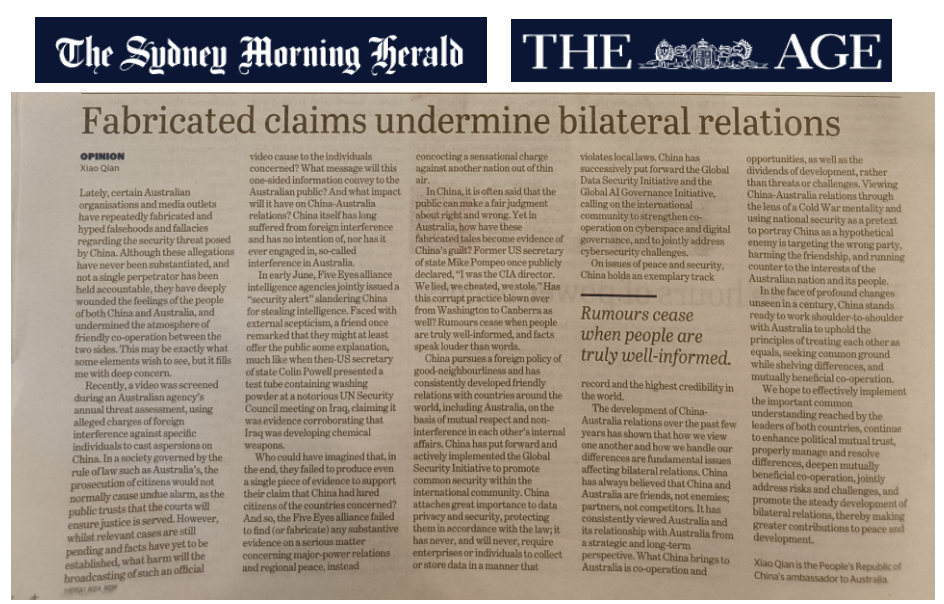
The full text is as follows:
Lately, certain Australian organisations and media outlets have repeatedly fabricated and hyped falsehoods and fallacies regarding the security threat posed by China. Although these allegations have never been substantiated, and not a single perpetrator has been held accountable, they have deeply wounded the feelings of the people of both China and Australia, and undermined the atmosphere of friendly cooperation between the two sides. This may be exactly what some elements wish to see, but it fills me with deep concern.
Recently, a video was screened during an Australian agency's annual threat assessment, using alleged charges of foreign interference against specific individuals to cast aspersions on China. In a society governed by the rule of law such as Australia's, the prosecution of citizens would not normally cause undue alarm, as the public trusts that the courts will ensure justice is served. However, whilst relevant cases are still pending and facts have yet to be established, what harm will the broadcasting of such an official video cause to the individuals concerned? What message will this one-sided information convey to the Australian public? And what impact will it have on China-Australia relations? China itself has long suffered from foreign interference and has no intention of, nor has it ever engaged in, so-called interference in Australia.
In early June, Five Eyes alliance intelligence agencies jointly issued a “security alert” slandering China for stealing intelligence. Faced with external scepticism, a friend once remarked that they might at least offer the public some explanation, much like when then-US Secretary of State Colin Powell presented a test tube containing washing powder at a notorious UN Security Council meeting on Iraq, claiming it was evidence corroborating that Iraq was developing chemical weapons. Who could have imagined that, in the end, they failed to produce even a single piece of evidence to support their claim that China had lured citizens of the countries concerned? And so, the Five Eyes alliance—touted as the world's most formidable alliance—failed to find (or fabricate) any substantive evidence on a serious matter concerning major-power relations and regional peace, instead concocting a sensational charge against another nation out of thin air.
In China, it is often said that the public can make a fair judgment about right and wrong. Yet in Australia, how have these fabricated tales become evidence of China's guilt? Former US Secretary of State Mike Pompeo once publicly declared, "I was the CIA director. We lied, we cheated, we stole." Has this corrupt practice blown over from Washington to Canberra as well? Rumours cease when people are truly well-informed, and facts speak louder than words.
China pursues a foreign policy of good-neighbourliness and has consistently developed friendly relations with countries around the world, including Australia, on the basis of mutual respect and non-interference in each other's internal affairs. China has put forward and actively implemented the Global Security Initiative to promote common security within the international community. China attaches great importance to data privacy and security, protecting them in accordance with the law; it has never, and will never, require enterprises or individuals to collect or store data in a manner that violates local laws. China has successively put forward the Global Data Security Initiative and the Global AI Governance Initiative, calling on the international community to strengthen cooperation on cyberspace and digital governance, and to jointly address cybersecurity challenges. On issues of peace and security, China holds an exemplary track record and the highest credibility in the world.
The development of China-Australia relations over the past few years has shown that how we view one another and how we handle our differences are fundamental issues affecting bilateral relations. China has always believed that China and Australia are friends, not enemies; partners, not competitors. It has consistently viewed Australia and its relationship with Australia from a strategic and long-term perspective. What China brings to Australia is cooperation and opportunities, as well as the dividends of development, rather than threats or challenges. Viewing China-Australia relations through the lens of a Cold War mentality and using national security as a pretext to portray China as a hypothetical enemy is targeting the wrong party, harming the friendship, and running counter to the interests of the Australian nation and its people.
In the face of profound changes unseen in a century, China stands ready to work shoulder-to-shoulder with Australia to uphold the principles of treating each other as equals, seeking common ground while shelving differences, and mutually beneficial cooperation. We hope to effectively implement the important common understanding reached by the leaders of both countries, continue to enhance political mutual trust, properly manage and resolve differences, deepen mutually beneficial cooperation, jointly address risks and challenges, and promote the steady development of bilateral relations, thereby making greater contributions to peace and development in the Asia-Pacific region and the world at large.