
On January 19, 2026, Chinese Ambassador to Australia Xiao Qian published an article entitled “Respect Facts, Honour Commitments, and Keep Abreast of the Historical Trend” on the Australian mainstream newspaper The Australian, in response to the recent statement on Taiwan issued by the Australian Department of Foreign Affairs and Trade. The article notes that one-China principle is the most fundamental truth regarding the Taiwan question. The “special state” of political confrontation between the two sides of the Taiwan Strait has never changed the fundamental nature of Taiwan as part of China, and the separatist forces and external forces are the very culprit undermining stability across the Taiwan Strait. “Dialogue” should never be used as a pretext to connive at separatist activities. The Australian side should respect its political commitments, understand and support China’s national reunification.
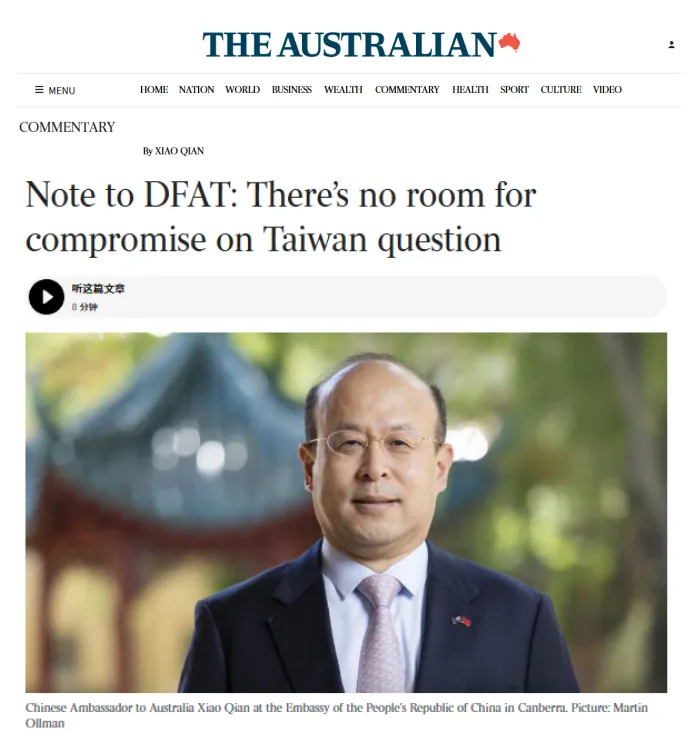
The full text is as follows and can be accessed via https://www.theaustralian.com.au/commentary/note-to-dfat-theres-no-room-for-compromise-on-taiwan-question/news-story/c6002ce8fc960e66df0c462cc0a2c179
The Department of Foreign Affairs and Trade (DFAT) of the Australian Government recently released a public statement on the military drills conducted by the Chinese People’s Liberation Army in areas near the Taiwan Island. It accused China of changing the status quo and undermining stability, called for dialogue and opposed the use of coercion. The statement, in disregard of facts, seriously violates the Australian government’s one-China political commitment. The Chinese side has lodged representation to the Australian side over it. Hereby, I, together with the Australian audiences, would like to clarify the underlying facts .
First, what is the truth? A total of 183 sovereign countries around the world have established diplomatic relations with China on the basis of the one-China principle. It is clearly stated in the official legal opinions of the United Nations that “the United Nations considers ‘Taiwan’ as a province of China.” All these fully demonstrates that the one-China principle is a prevailing international consensus, constituting the most fundamental truth regarding the Taiwan question. Upholding the one-China principle also bears on the political foundation of China-Australia relations. The Joint Communiqué Concerning the Establishment of Diplomatic Relations Between China and Australia signed in 1972 clearly states that, “The Australian Government recognises the Government of the People’s Republic of China as the sole legal Government of China, acknowledges the position of the Chinese Government that Taiwan is a province of the People’s Republic of China.” This solemn commitment has been recognised by successive Australian governments. Taiwan is a province of China, just as Tasmania is a state of Australia. This is the only correct understanding of “one China”. Compromising or even openly distorting this principle will only mean backpedalling on one’s position, dishonoring commitments, and undercutting trust and credibility. As a Western saying goes, he who does not keep faith will find no faith in others. A country that fails to honor its commitments is destined to find no standing in the international community.
Second, who is changing the status quo? The only true status quo across the Taiwan Strait is that there is but one China in the world, Taiwan is an inalienable part of China’s territory, and the government of the People’s Republic of China is the sole legal government representing the whole of China. This is an integral part of the international order established by a series of international instruments after the World War II. The Taiwan question is a legacy of the Chinese civil war. The “special state” of political confrontation between the two sides of the Taiwan Strait has never changed the fundamental nature of Taiwan as part of China, nor should it serve as an excuse to deliberately distort and obscure the cross-Strait status quo. Taking such a “special state” for granted is like staying in a cave so long that one mistakes the firelit shadows for reality. Connivance and support of “two Chinas” or “one China, one Taiwan” under the pretext of the “status quo” represent a dangerous move to challenge and change the status quo across the Taiwan Strait.
Third, who is undermining stability? Blood runs thicker than water, and fellow Chinese on both sides of the Taiwan Strait belong to one and the same family. The central government of China has steadfastly pursued the prospect of peaceful reunification across the Taiwan Strait with the utmost sincerity and endeavour. In 1979, the Standing Committee of China’s National People’s Congress issued the Message to Compatriots in Taiwan, solemnly declaring the fundamental guideline for peaceful reunification. In 1992, the two sides of the Taiwan Strait reached the 1992 Consensus, agreeing that both sides belong to one China and should work together for reunification. In 2015, China adopted the Anti-Secession Law, stipulating that peaceful reunification remains the first choice for China to resolve the Taiwan question. China, however, does not commit to renouncing the use of force, with the aim of deterring the “Taiwan independence” separatist forces and external forces and preventing their risky actions. Today, to contain China with Taiwan issue, certain external forces have been actively engaged in arms sales to Taiwan, an act that has been intensifying cross-Strait confrontation, stirring up tensions, and severely undermining China’s efforts to resolve the Taiwan question through peaceful means. The separatist forces’ attempt to seek “Taiwan independence” through military buildup, as well as the support and connivance of external forces are the very culprit undermining stability across the Taiwan Strait.
Fourth, “dialogue” can be a means of advancing China’s reunification, but should never be used as a pretext to connive at separatist activities. The Taiwan question is China’s internal affair, and its resolution is a matter for the Chinese people. The prerequisite for resolving the Taiwan question through dialogue is that both sides of the Taiwan Strait belong to one and the same China. The purpose of dialogue should be achieving the reunification of the two sides, and it should not serve as an excuse to delay or obstruct the reunification, nor should it be used as a shield for separatist forces to seek “incremental independence.” To speak of “dialogue” without acknowledging the One-China principle is a hypocritical act devoid of goodwill, essentially using dialogue as a pretext to pursue self-serving interests. On the premise of supporting China’s reunification, the central government of China always keeps its door open to dialogue. However, engaging in dialogue with “Taiwan independence” separatist forces, who are like extreme terrorists, is tantamount to asking a tiger for its hide. The Chinese government strives for peaceful reunification, but if provocations and coercion by “Taiwan independence” forces continue to escalate, we will resolutely crack down on them. In essence, this is no different to the logic behind the United States’ decision to go to war to safeguard its national unity in the mid-19th century.
Fifth, dealing with Taiwan-related issues properly is of particular significance for the sound and stable development of China-Australia relations. China has long been Australia’s largest trading partner and the largest source of Australia’s trade surplus. Australia has benefited enormously from trade with China which plays an irreplaceable role in driving Australia’s economic and social development and improving the well-being of its people. China stands ready to develop bilateral relations, guided by the principles of mutual respect, seeking common ground while reserving differences, and mutual benefit and win-win cooperation. Meanwhile, the Taiwan question is at the very core of China’s core interests, as it bears on the integrity of China’s sovereignty and territory, and the strong aspiration of all Chinese people for reunification. There is no room for compromise or concession on the Taiwan question, nor will China allow any country to use it as a bargaining chip. It is both inadvisable and unacceptable on moral grounds to seek cooperation with and benefits from China while simultaneously disregarding China’s concerns and undermining its core interests.
China and Australia are important countries in the Asia-Pacific, and the development of bilateral relations is of great significance to both sides and the region. In recent years, with the joint efforts of both sides, China-Australia relations have achieved a full turnaround and are now making steady progress. Maintaining the sound and stable growth of bilateral relations serves the common interests of both sides, and we must handle the Taiwan question with prudence in this process. Given the unstoppable trend of reunification across the Taiwan Strait, Australia should prepare for engaging with a reunified China. The Chinese people will appreciate and reciprocate the goodwill of those who support China’s reunification, but will not forgive anyone that attempts to obstruct or undermine the process of reunification. China and Australia are comprehensive strategic partners. We hope Australia will keep abreast of the historical trend on the Taiwan question, understanding and supporting the Chinese people’s endeavours for national reunification.